Moisture Mapping and Drying Logs That Back Up Your Scope
Quick answers
- What is moisture mapping in water damage restoration? Moisture mapping is the process of measuring and recording moisture levels in affected materials to establish the extent of a water loss and track drying progress against a dry standard.
- What is a drying log? A drying log is the daily record of moisture readings, psychrometric conditions, and equipment on a water loss, used to prove a structure dried to standard over a documented timeline.
- What is a dry standard in water restoration? A dry standard is the moisture reading taken from an unaffected material of the same type in the same building, used as the target the affected material must reach before drying is complete.
- What is grain depression in psychrometric readings? Grain depression is the difference between a dehumidifier's intake and exhaust grains per pound; a healthy gap shows the dehumidifier is actively pulling moisture from the air.
- How often should moisture readings be taken during a water loss? Daily, at the same monitoring points and same time each visit, so the readings build a consistent trend line toward the dry standard.
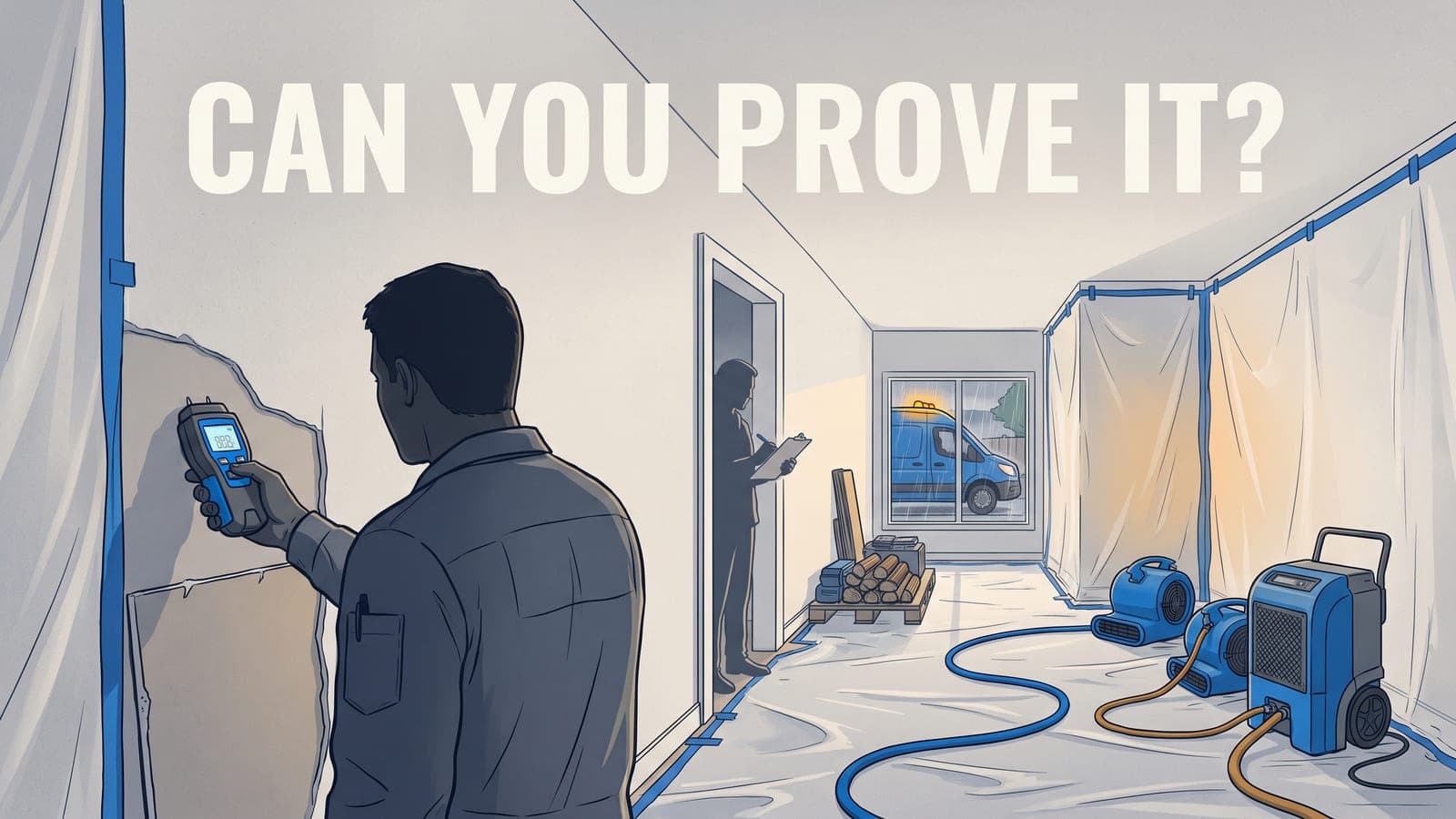
Every water loss eventually comes down to one question: can you prove it? Prove the moisture was there, prove you dried it, prove how long it took, and prove the equipment you billed actually had a reason to be on the floor. When the adjuster pushes back on your invoice, it isn't your gut feeling that wins the argument. It's the numbers on the page.
That page is your drying log. And the readings that fill it come from your moisture mapping. Get both right, day after day, and your scope holds up. Get sloppy, and you're eating equipment days or arguing about a category you can't defend.
Here's how to think about moisture mapping and drying logs as documentation that protects you, not busywork you do at the end of the day in the truck.
Why the readings are the whole job
Water mitigation is one of the few trades where the work and the proof are the same activity. You can't dry a structure without measuring it, and you can't bill the drying without showing the measurements. The IICRC S500 framework is built around this: establish a dry standard, document the affected materials, monitor daily, and stop when you hit goal.
When you skip or fake the middle part, the whole chain breaks. A few things that go sideways without solid documentation:
- Equipment gets cut. No daily readings showing elevated moisture means no justification for the air movers and dehus you ran for five days. The adjuster pays for two and you swallow three.
- Category and class get questioned. Your initial mapping is what supports a Category 2 or 3 call and the class of water you scoped. Thin documentation invites a downgrade.
- Mold callbacks become your problem. If you closed the job at "looks dry" instead of "reads dry to standard," and something blooms in the cavity later, you have nothing to point to.
- The timeline falls apart. Drying takes the time it takes. Without a daily record, "it needed four days" is an opinion. With one, it's a fact.
The readings are not paperwork about the job. They are the job, written down.
What good moisture mapping actually looks like
Mapping is more than poking a meter at a baseboard. On the first visit you're building the baseline the entire claim rests on.
Establish your dry standard first
Find an unaffected material of the same type in the same building and take a reading. That's your target. Drywall dries to drywall, wood to wood. Without a dry standard you're chasing an arbitrary number, and so is the adjuster.
Map the affected area, not just the wet spot
Trace the migration. Water moves up walls, under cabinets, across subfloor, into adjacent rooms. Use a non-penetrating meter to find the perimeter of the moisture, then penetrating meters and an infrared camera to confirm what's wet inside the assembly. Document the affected rooms and the materials in each:
- Room and elevation (north wall, base of south cabinet run)
- Material type (drywall, hardwood, OSB subfloor, plaster)
- Reading and the meter mode used
- Whether it's affected, at goal, or being demoed
Tie photos to the readings
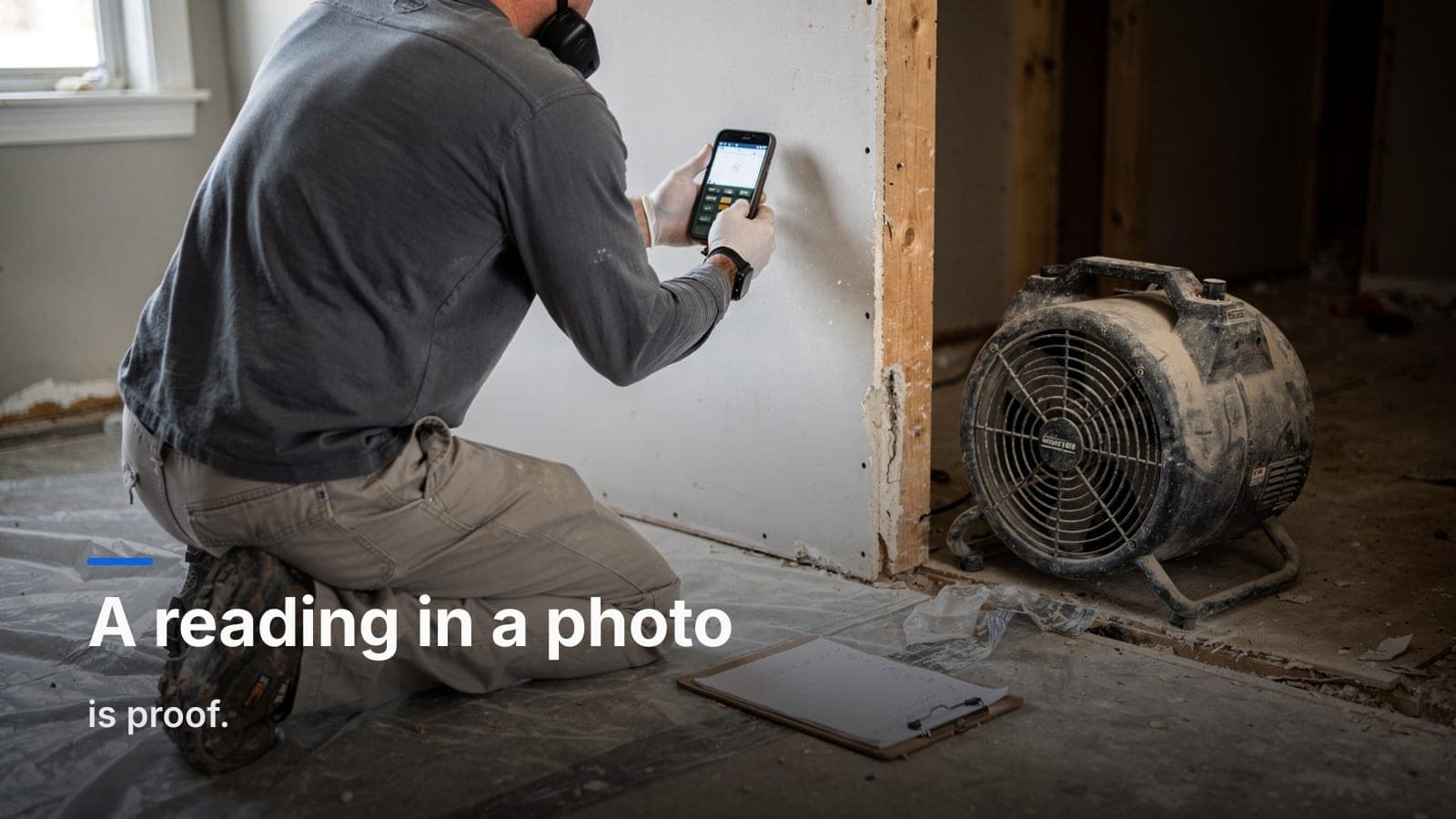
A moisture reading with a photo of the meter on the wall is worth ten readings on a spreadsheet nobody can verify. Photos of the affected area, the equipment placed, and the meter in contact with the material turn your log from a claim into evidence.
If you want a deeper field routine for documenting a space room by room, the same discipline that makes a contents inventory survive an audit applies to mapping a structure.
The psychrometric side people skip
Material readings tell you what's wet. Psychrometric readings tell you whether your drying setup is actually working. You need both.
At each visit, log the conditions:
- Outside temperature and relative humidity
- Unaffected/ambient area readings
- Affected area readings
- Dehumidifier intake and exhaust (grain depression tells you the dehu is pulling water)
Grain depression is the number that proves your equipment is doing its job. If your intake and exhaust grains are nearly identical, the dehu isn't producing, and you want that on record before someone asks why drying stalled on day three. The psychrometrics also justify changes mid-job: if you add a dehu or swap to a desiccant, the readings explain why.
This is the part that separates a defensible drying log from a column of numbers. Material moisture trending down plus a healthy grain depression equals a job that's drying on plan. That's a story an adjuster pays.
Daily logs: same readings, same time, every visit
Consistency is what makes a log credible. Reading the same monitoring points, the same way, once a day, builds a trend line that's hard to argue with. Bounce around your points or skip a day and the trend gets noisy, and noisy data is data someone can pick apart.
A clean daily entry has:
- Date and time of the visit
- Tech who took the readings
- Psychrometric conditions (outside, ambient, affected, dehu in/out)
- Material moisture at each monitoring point, compared to the dry standard
- Equipment on site and running
- Photos
- A short note on progress and any decisions made
Day over day, you're showing a line that drops toward the dry standard. When it flattens, you adjust the drying environment and your log shows you caught it. When it hits goal, you pull equipment and the log shows exactly why you stopped on that day and not the one before.
The paperwork problem, and how to kill it
Here's the honest part. Most techs know all of this. The reason logs end up thin isn't ignorance, it's friction. After a long day of demo and equipment placement, nobody wants to transcribe meter readings off a clipboard into a spreadsheet, hunt down the photos, and email it to the office. So it gets done at the end of the week from memory, or it doesn't get done at all.
That gap is where claims get weak. The fix is capturing the readings once, in the field, on the same job they belong to, and never touching them again.
That's the core of how the restoration and mitigation tools in JobWorkflowPro are built. The drying log lives on the job, not in a separate binder:
- Log readings from the field on the mobile app while you're standing at the wall, not hours later from notes you can barely read.
- Photos attach to the reading and the job automatically, so the meter shot and the room are tied to the entry, not floating in someone's phone.
- Everything sits with the claim — claim number, carrier, adjuster, and the e-signed work authorization — so when you assemble the file, the moisture mapping and daily logs are already in one place.
- Custom job statuses track the loss from inspection through monitoring to dry-out, so the office always knows which jobs need a visit today.
The point isn't fancy software for its own sake. The point is that the tech captures the reading the moment it happens, and the documentation builds itself as the job runs. No end-of-week catch-up. No "I think it was around 18 percent." Just a clean, dated, photo-backed record that's ready before the adjuster ever asks.
What it buys you
When your moisture mapping and drying logs are tight, three things happen. You get paid for the equipment days you actually ran, because you can show why each unit was there. Your timeline holds, because the trend line proves the structure needed the time. And your callbacks drop, because you closed to a documented dry standard instead of a guess.
That's not extra work. It's the same work you're already doing, captured once and kept where it counts.
Get your drying logs out of the truck
If your moisture readings are still living on clipboards and getting typed up days later, you're leaving documentation strength on the table, and sometimes leaving money there too. Capturing readings in the field, tied to the claim and backed by photos, is the difference between defending your scope and arguing about it.
Frequently asked questions
What's the difference between moisture mapping and psychrometric readings?
Moisture mapping measures moisture content directly in materials like drywall or subfloor; psychrometric readings measure the air itself (temperature and humidity) to show whether the drying equipment is actually working.
What tools are used for moisture mapping?
A non-penetrating meter to find the perimeter of the affected area, penetrating meters and an infrared camera to confirm what's wet inside the assembly, and a hygrometer for psychrometric readings.
Who should take daily moisture readings on a job?
The same tech taking consistent readings from the same monitoring points builds a more reliable trend line than readings that bounce between different techs or points day to day.
What happens if drying equipment is left on a job without documented moisture readings?
The adjuster has nothing to justify the equipment days against, which is a common reason carriers cut equipment time from an invoice.
Can moisture mapping software attach photos to individual readings?
Yes — Job Workflow PRO's restoration module attaches photos directly to each reading and job so the documentation builds itself in the field instead of getting reconstructed later.
Want to see how the drying log and moisture mapping work on a real job? Start a free trial and run your next water loss through it, or email us at sales@jobworkflowpro.com and we'll walk you through how restoration crews are using it. No pressure either way.