Soot & Odor on Contents: Document the Cleaning So It Pays
Quick answers
- How do you document contents cleaning on a fire loss? Record the cleaning method per item (dry sponge, wet wash, ultrasonic, ozone/hydroxyl), paired before/after photos, and the labor time, so each charge ties to a visible result.
- What cleaning methods show up on a fire contents inventory? Dry sponging for light soot, wet cleaning for washable hard goods, ultrasonic for detailed and layered items, and chamber deodorization (ozone or hydroxyl) for odor.
- When should you replace instead of clean? When the cleaning labor plus supplies approaches or passes the item's actual cash value, replacement is the cheaper call and you should document why.
- Why does odor removal need its own documentation? Deodorization is invisible in a photo, so you prove it with chamber logs, treatment time, and a sign-off that the item passed a smell check before pack-back.
- What makes a carrier pay for contents cleaning? A line item they can audit: method, time, before/after images, and a disposition that makes economic sense against replacement cost.
A fire loss generates two kinds of contents work, and adjusters treat them very differently. The first is obvious soot you can photograph. The second is odor, which is real, expensive to remove, and completely invisible in a before/after shot. If you bill both the same way, you'll get paid for one and fight for the other.
The fix isn't more words on the estimate. It's documenting the method and the time behind every cleaned item, so a desk reviewer can see exactly what you did and why it cost what it cost. Here's how I run it.
Document the cleaning method, item by item
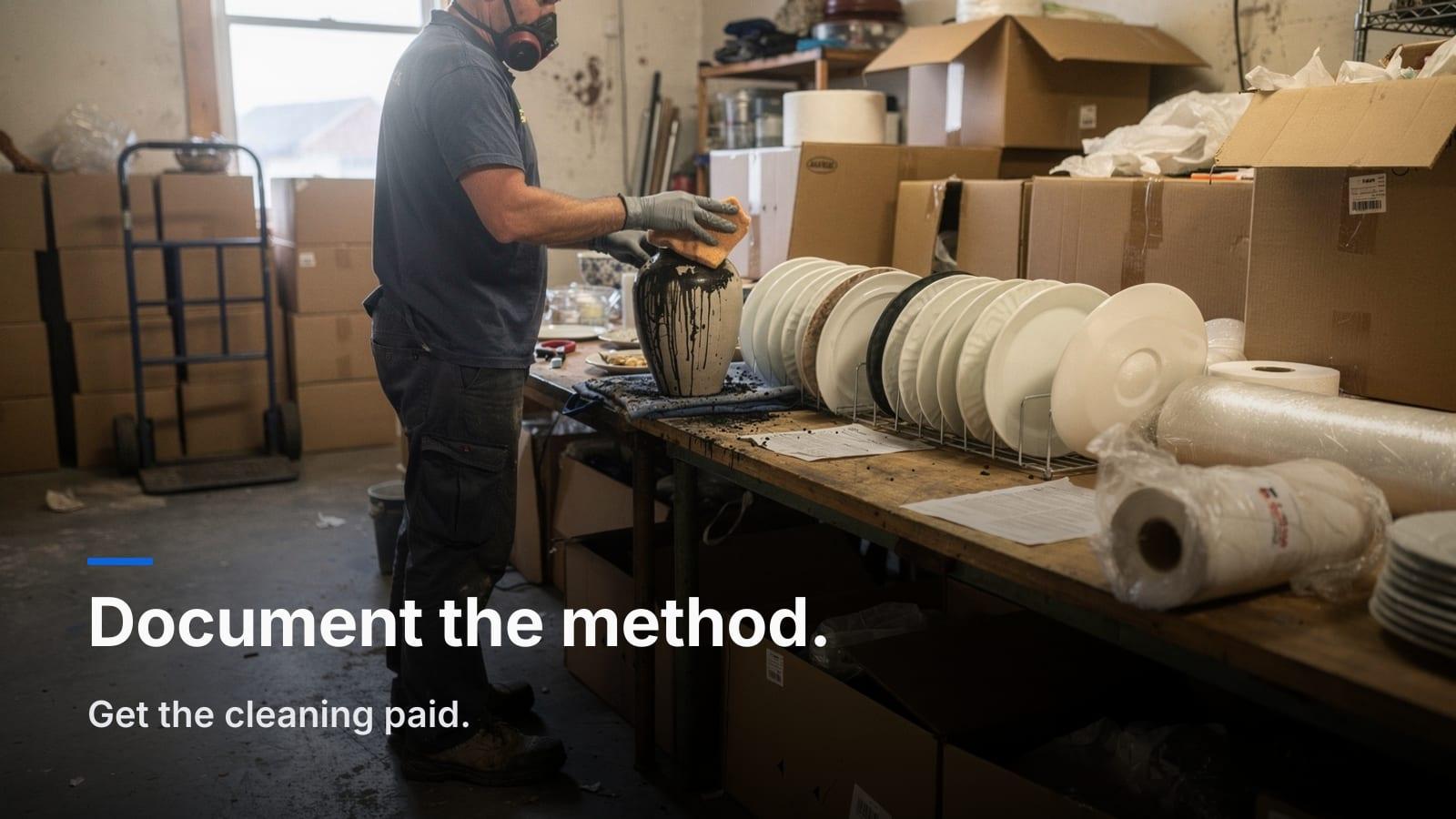
Soot cleaning on contents fire damage isn't one process. It's a decision tree, and the method you pick drives the labor. A dry sponge pass on a ceramic vase is a two-minute job. The same vase with baked-on protein soot and detailed glaze might need ultrasonic and a hand-dry. Carriers know this, which is why "cleaned contents — 6 hrs" with no method attached gets questioned.
Tag every item or batch with the method you used:
- Dry sponge / dry cleaning — light, dry soot on porous or delicate surfaces. The first pass on almost everything.
- Wet cleaning — washable hard goods: dishes, glassware, sealed ceramics, metal, most plastics.
- Ultrasonic cleaning — the workhorse for detailed, layered, or awkward items (figurines, blinds, hardware, small mechanical pieces). Restoration ultrasonic tanks pull soot out of crevices a rag never reaches, and the method itself signals skilled labor on the invoice.
- Deodorization — ozone or hydroxyl chamber time for items holding smoke odor after surface cleaning.
The point of logging method is that it maps labor to result. When your room-by-room inventory carries a method field, your per-item time stops looking arbitrary. It looks like a scope.
Light, medium, heavy soot — call it on the item
Before you touch anything, grade the soot. Light, medium, heavy. It takes a second and it explains everything downstream: why one box of kitchenware wet-washed in twenty minutes while the next needed ultrasonic plus a re-clean. Protein soot from a grease fire behaves nothing like the dry, flaky soot off a structure fire, and the grading note is where you record that reality so nobody has to take your word for it later. Our fire and smoke documentation guide digs deeper on reading soot types in the field.
Before and after, paired to the item
Loose photos in a folder are useless when the adjuster asks "which vase?" The photo has to live on the item record. One before, one after, same item, same angle. That pairing is what turns a labor charge into a defensible one — the reviewer sees soot, then sees clean, and the time in between stops being a question.
A few habits that keep photos from getting bounced:
- Shoot the dirty side. A before photo of the clean back of a lamp proves nothing.
- Keep lighting consistent between the two shots so the "after" actually reads as cleaner.
- Catch the detail work — ultrasonic results on a carved frame or vent grille sell themselves.
If carrier pushback on photos is a recurring headache, the fundamentals in how to photograph contents so the carrier doesn't push back apply directly to fire work.
Odor is the hard part — document what the camera can't see
Here's where a lot of contents shops leave money on the table. You can wet-wash a hundred pieces of glassware and the photos carry the bill. But odor removal contents documentation is a different animal, because a deodorized item looks identical to a soot-covered one in a photo. If the only proof you have is "we ran it through ozone," expect friction.
Prove deodorization the way you'd prove drying on a water loss — with a log, not a vibe:
- Chamber in / chamber out timestamps per batch.
- Treatment type and run time (ozone hours, hydroxyl hours, how many cycles).
- A pass/fail smell check before the item goes back on the pack-back shelf, with the tech who cleared it.
That treatment log is the deodorization equivalent of moisture mapping and drying logs. It converts invisible work into a record a desk adjuster can audit without standing in your warehouse. Items that fail the smell check go back through, and you log that too — the re-treatment is legitimate labor, and the log is what justifies it.
Track the time, because cleaning is labor
Contents cleaning on fire jobs is labor-heavy and that's the whole ballgame on profitability. If your techs are cleaning off a clipboard and you're reconstructing hours at invoicing, you're guessing — and guessing low, usually.
Clock the work against the job. A per-job timesheet an adjuster will actually approve shows billing rates and hours tied to the contents cleaning line, never your pay rates. When the method log, the photo pairs, and the hours all point at the same batch of items, the T&M bill reads as one coherent story instead of three disconnected claims.
It also feeds your own numbers. Run restoration job costing on the cleaning labor and you'll quickly learn which item types eat hours and which clean fast. That's the data that makes your next bid honest.
When cleaning costs more than replacing
This is the call that separates a pro from a line-item filler. Not everything should be cleaned, even if it can be. Twelve hours of ultrasonic and hand-detail on a set of mass-market picture frames is money the carrier shouldn't pay and the customer shouldn't eat — those get replaced.
The rule I use: if the cleaning labor plus supplies approaches the item's actual cash value, it's a replacement. Cleaning wins when the item is high-value, sentimental, or genuinely cheaper to restore than to buy new. And the disposition has to be documented either way — "non-restorable, replace" needs a reason on the record just like "cleaned" does. The restorable vs. non-restorable call is the backbone of a defensible contents scope, and getting the economics right on fire items protects your margin and your credibility with the desk.
Where it gets murky — electronics with smoke intrusion, upholstered furniture, anything porous holding odor — lean conservative and document the why. A short note ("foam core holds smoke odor, deodorization not reliably effective, recommend replacement") does more for approval than an optimistic cleaning charge that gets denied two weeks later.
Put it in one record, not five apps
The reason all of this works is that it lives on the item, in one job record — method, soot grade, before/after photos, deodorization log, time, and disposition. Scattered across a camera roll, a paper log, and a spreadsheet, none of it holds up. On one contents record, it's an audit trail that pays.
That's exactly what the contents module in Job Workflow PRO is built to carry: room → box → item inventory with photos, condition and disposition workflows, and customer approvals, with the method and odor documentation sitting right on the item it describes.
Frequently asked questions
Does ozone or hydroxyl work better for contents deodorization?
Hydroxyl is safer to run around occupied space and gentler on sensitive materials, while ozone is more aggressive and requires an unoccupied sealed chamber. Many shops use hydroxyl for most contents and reserve ozone for stubborn, isolated odor — document whichever you use with run time and a post-treatment smell check.
How do you handle smoke odor in electronics?
Treat electronics as specialty items: surface-clean the exterior, but corrosive smoke residue inside a device often means an electronics restoration specialist or replacement. Document the intrusion and your recommendation rather than running consumer electronics through a general cleaning line.
Should fire contents cleaning be billed T&M or by line item?
Insurance contents cleaning is commonly billed time and materials because labor drives the cost and varies by soot load. Tie the hours to a per-job timesheet with billing rates and back them with your method and photo documentation so the T&M total is auditable.
What's the difference between cleaning in place and packing contents out for a fire?
Clean-in-place keeps belongings on site when soot is light and the structure is stable; a pack-out moves them to a controlled facility for detailed cleaning and deodorization when the loss is heavy. See pack-out vs. clean-in-place for how to make that call.
If you're documenting fire contents on paper or a spreadsheet and feeling the pushback at invoicing, it's worth seeing what one item record can carry. Start a free trial or reach out at sales@jobworkflowpro.com — happy to talk through how you run cleaning on your fire jobs.