Category 3 and Sewage Losses: Safety, Scope, and Documentation
Quick answers
- What is Category 3 water damage? Category 3 is grossly contaminated "black water" — sewage backups, flood water, or any water that has sat long enough to grow a microbial problem — and it carries pathogens that make most porous materials non-salvageable.
- Do you have to remove drywall and flooring on a Cat 3 loss? Yes, as a rule — porous and semi-porous materials that contacted black water (drywall, carpet, pad, insulation, particleboard) get demoed to a clean line, because you can't reliably clean contamination out of them.
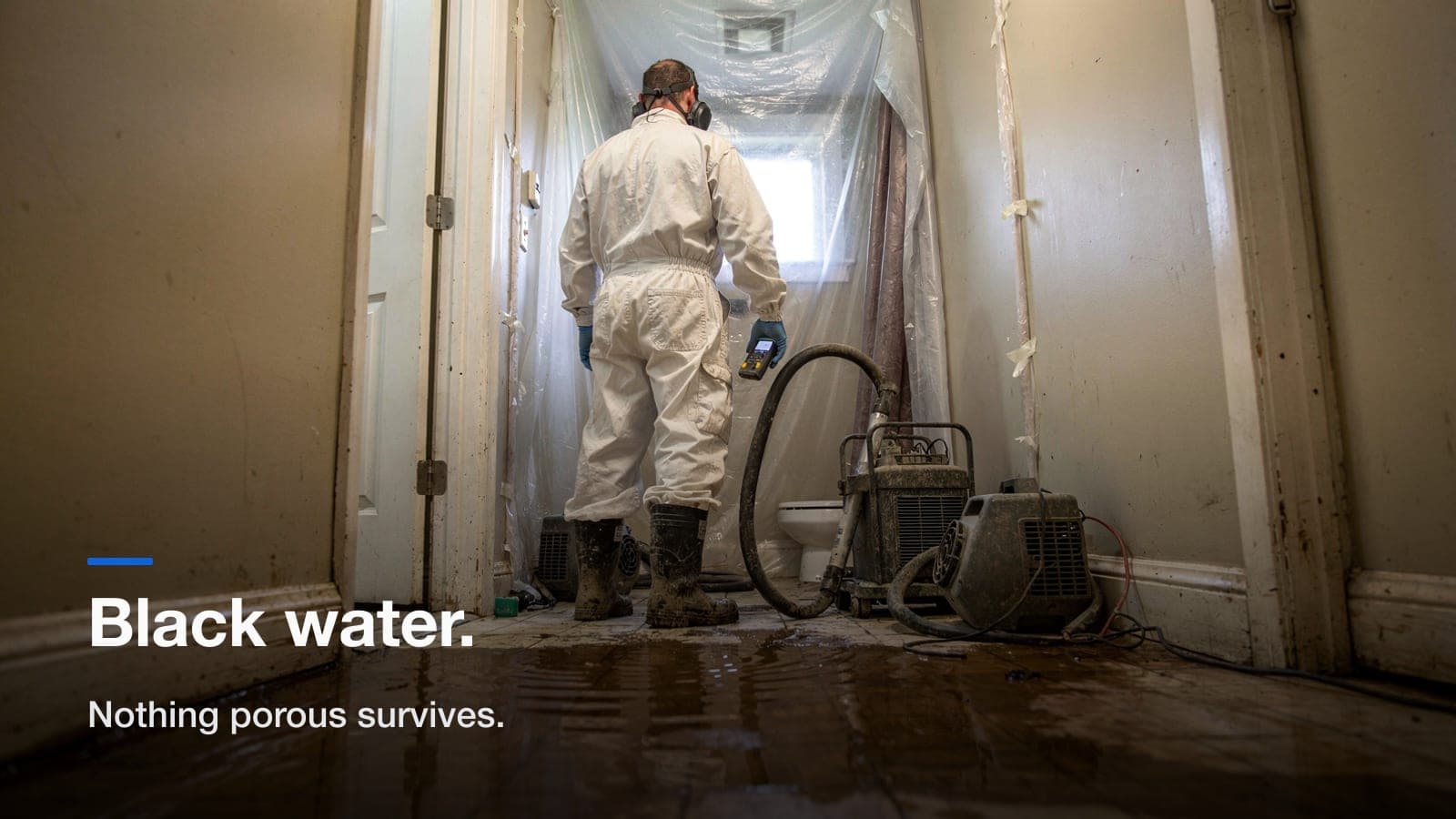
- What PPE does a sewage loss require? At minimum a Tyvek suit, rubber boots, nitrile or chemical-resistant gloves, and a half-face respirator with the right cartridges, plus containment to keep the affected area isolated.
- How do you document a Category 3 job? Photograph the source and contamination before you touch anything, log the category and your reasoning, document demo lines and disinfection, and keep moisture readings through drying — all tied to the claim.
- Can a Cat 3 loss ever be cleaned in place? Non-porous and some semi-porous structural materials (tile, sealed concrete, hardwood in some cases) can be cleaned and sanitized, but soft goods and anything saturated with sewage usually go to the dumpster.
A Category 3 job is not a bigger Category 1. It's a different animal. The water is contaminated, the materials are mostly lost, and the liability if you get it wrong — to the occupant's health and to your own crew — is real. Carriers know this, which means they scrutinize Cat 3 scopes harder than a clean supply-line leak. If your documentation doesn't back up why you pulled two feet of drywall and a room of carpet, you're going to eat the pushback.
This is the workflow I run on black water mitigation: protect the crew first, scope to a defensible clean line, and document every decision so the file stands on its own. Let's walk it.
Confirm the category before you commit the scope
Category drives everything downstream — PPE, demo, drying approach, and what you bill. Get it wrong early and the whole file is built on sand.
Category 3 water is grossly contaminated. The textbook sources are sewage backups, toilet overflows past the trap, rising ground water or storm flooding, and seawater. But category isn't only about the source — it's also about time and temperature. A Category 1 supply-line break that sat for days in a warm, dark crawlspace can degrade to a Cat 2 or Cat 3 by the time you arrive. If you're fuzzy on where the lines are, the breakdown of water damage categories 1, 2, and 3 walks through how each one changes your scope.
The practical move: make the call on site, write down why, and photograph the evidence. "Toilet supply overflow, standing water with visible solids, occupant reports 36+ hours before discovery — classified Category 3" is a sentence that holds up. "Cat 3" with no reasoning does not.
Safety and containment come before the wet-vac
Before anyone starts extracting, the area gets isolated and the crew gets suited. This isn't optional and it isn't the step you skip because the occupant is anxious to see progress.
PPE for a sewage loss:
- Full Tyvek suit (taped at the wrists and boots if the contamination is heavy)
- Rubber boots, not booties
- Nitrile or chemical-resistant gloves — double up for handling saturated material
- Half-face respirator with cartridges rated for the hazard; upgrade to full-face if you're power-washing or aerosolizing
- Eye protection if you're not in a full-face
Containment:
Hang poly across openings to the affected area so you're not tracking contamination through the rest of the home. On a bathroom backup that means sheeting the hallway before you ever bring the wet-vac in. Set up a clean staging zone, a dirty zone, and a path for carrying out demo debris that doesn't cross living space.
Negative air with HEPA filtration is your friend here, especially once demo starts kicking contaminants into the air. Document the containment with photos — it shows the carrier (and anyone who ever reviews the file) that you ran the job to standard.
Scope the demo to a defensible clean line
Here's where Cat 3 scopes get challenged, so here's where your reasoning has to be airtight. The governing principle: porous materials that contacted Category 3 water are not restorable. You can't sanitize the inside of drywall or the core of a carpet pad. It comes out.
What typically goes:
- Drywall — cut to a clean line above the water line (commonly 2 feet, higher if wicking or materials dictate)
- Carpet and pad
- Batt insulation
- Particleboard, MDF, and laminate substrates
- Base trim that's porous or saturated
What can often stay, cleaned and sanitized:
- Tile and sealed grout
- Sealed concrete slab
- Solid dimensional lumber framing (clean, treat, dry, verify)
- Non-porous fixtures
The gray zone — hardwood flooring, some cabinetry — is a judgment call based on saturation and construction. When you make that call, document the reasoning the same way you documented the category. A scope that reads like a decision log gets approved faster than one that reads like a demand. If you want the extraction-vs-tearout logic in more depth, pack-out vs. clean-in-place covers how to make that call on contents, and the same restorable/non-restorable thinking applies to structure.
Disinfection and the drying phase
Once the contaminated materials are out and surfaces are cleaned, you apply an appropriate EPA-registered antimicrobial to the remaining structure. Then — and only then — you set drying equipment and start your moisture log.
Cat 3 doesn't exempt you from proving the structure dried. If anything it raises the bar, because you've got remaining framing and substrate that got wet. Set drying goals, take daily readings, and hold your moisture mapping and drying logs tight so you can prove the materials you kept actually reached dry standard before you pulled equipment.
Documentation that survives a review
A Cat 3 file gets looked at. Build it so it answers questions before anyone asks.
The paper trail I expect on every black water job:
- Source and pre-loss photos — the overflow, standing water, visible contamination, the water line on the wall. Shoot before you touch anything.
- Category classification with written reasoning — source, time, visible indicators.
- Containment and PPE — photos of the poly, the staging zones, the air scrubber running.
- Demo documentation — before, during, and after each area, with the clean line visible and measured.
- Disinfection record — product used, areas treated, application method.
- Drying log — moisture readings by day, equipment placement, drying goals, and the readings that justified pulling equipment.
- Everything tied to the claim — claim number, carrier, adjuster, and the authorization signed before work started.
That last point is where a lot of crews leave money and defensibility on the floor. If the photos live on three techs' phones, the readings are on a clipboard in the truck, and the authorization is a text message, you don't have a file — you have a pile. Keeping the claim number, carrier, and adjuster attached to one job record from the first photo onward is the whole game; insurance restoration job tracking gets into how that structure speeds approvals.
The platforms built for this — including our own restoration module — keep the insurance fields, the moisture logs, the threaded photos, and the e-signed authorization on a single job so that when an adjuster or a reviewer asks "why did you pull that flooring," the answer is two taps away instead of a scavenger hunt.
A clean sequence you can hand a new tech
- Arrive, assess, confirm Category 3 — photograph and write the reasoning.
- Get the work authorization signed before demo.
- Suit up: Tyvek, boots, gloves, respirator.
- Hang containment and set negative air.
- Extract standing water.
- Demo porous materials to the clean line, documenting as you go.
- Clean and apply antimicrobial to remaining surfaces.
- Set drying equipment, establish goals, start the log.
- Monitor daily until dry standard is verified.
- Pull equipment with readings that prove it.
Run it in that order every time and the safety, the scope, and the documentation all take care of each other.
Frequently asked questions
Does every toilet overflow count as Category 3?
If the overflow is clean supply water that never passed the trap, it can start as Category 1. Once it carries waste from the bowl or the toilet backs up from the drain side, treat it as Category 3.
How high do you cut drywall on a sewage loss?
Two feet above the water line is the common default, but the real answer is "above where the material is wet and above visible contamination." Verify with a moisture meter and cut to a clean, dry line — document the height you chose and why.
Can framing be saved after Category 3 water?
Usually yes — solid dimensional lumber is non-porous enough to clean, treat with antimicrobial, and dry to standard. The requirement is that you actually verify it dried; keep the moisture readings to prove it.
Who is liable if a Cat 3 job is done wrong?
You are, which is why PPE, containment, and documentation aren't bureaucracy. Cutting corners on a black water loss puts your crew and the occupants at health risk and leaves you exposed if the job is ever reviewed.
What's the difference between Category 3 and a mold job?
Category 3 is about contaminated water at the time of loss; mold is about growth that develops afterward, often when a wet structure wasn't dried fast enough. A mishandled Cat 3 can turn into a mold remediation if drying lags, so the two are closely linked.
If you're running sewage and black water losses out of spreadsheets and camera rolls, the documentation gap is where you lose approvals and sleep. Job Workflow PRO keeps the claim, the containment and demo photos, the drying logs, and the signed authorization on one job record built for this work. Start a free trial or email sales@jobworkflowpro.com and we'll walk your workflow through it.