Writing a Water Mitigation Scope That Gets Approved First Try
Quick answers
- What is a water mitigation scope of work? It's the documented list of the emergency services you performed to stop and dry a water loss, with the reasoning and evidence that justify each line item to the carrier.
- Why do mitigation estimates get kicked back? Almost always for missing documentation: no moisture readings, thin photos, an equipment count that doesn't match the affected square footage, or a category that isn't backed up.
- What proves a drying claim? Daily moisture logs showing readings trending toward dry standard, atmospheric readings, and photos of placed equipment tied to specific rooms.
- How do you speed up mitigation estimate approval? Match every line item to a photo and a reading, justify your equipment math, and submit a complete package once instead of drip-feeding the adjuster.
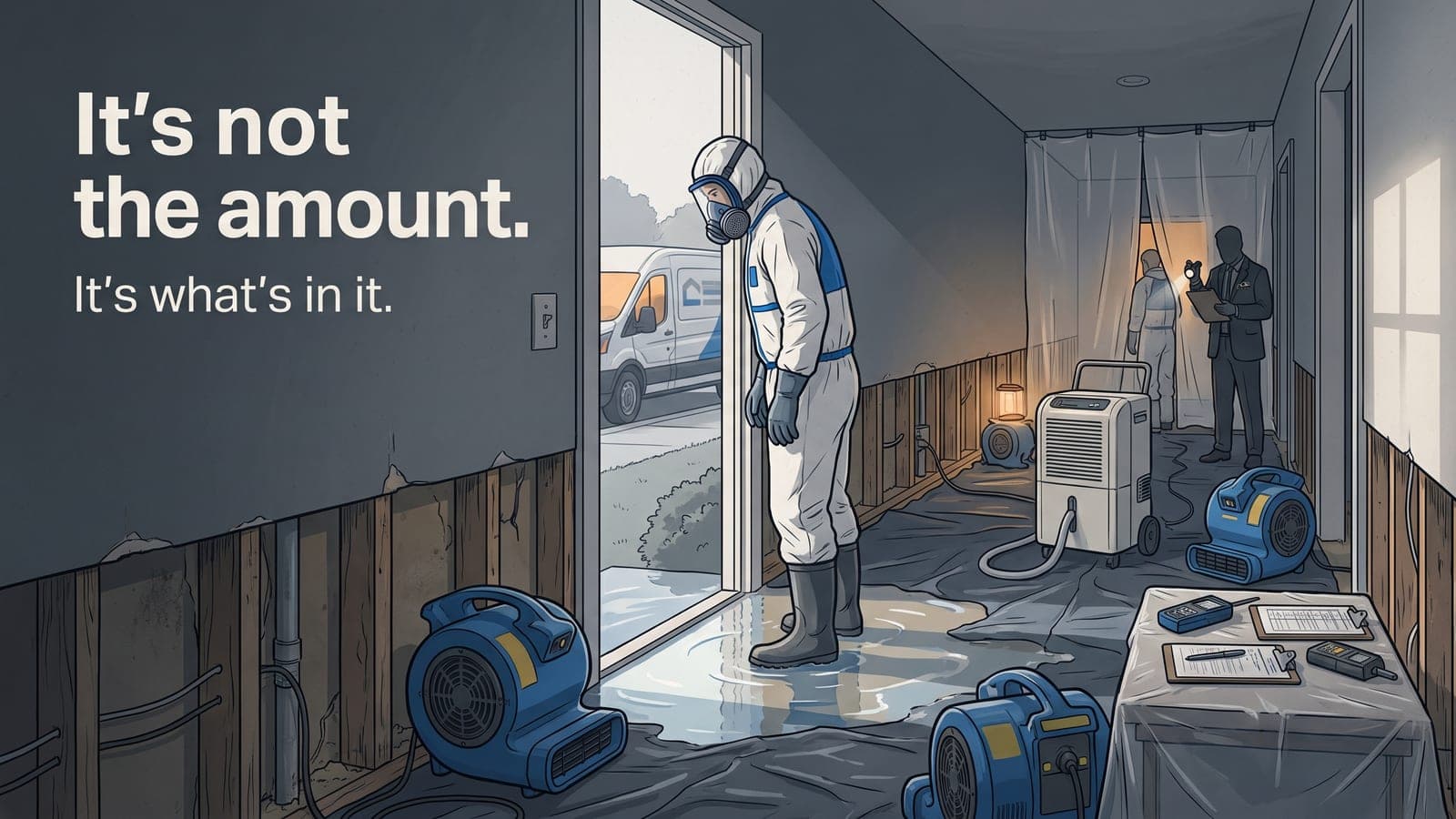
If you've been in the field more than a season, you know the feeling: you did clean, textbook work, and the estimate still comes back with red ink and a "please justify" note from a desk adjuster who never set foot in the house. The gap is almost never the work. It's the story you told about the work.
A water mitigation scope isn't a bid. It's an argument, and the adjuster is the audience. Your job is to make approving it the path of least resistance. Here's how to write a restoration scope of work that clears on the first pass.
Start with the category and class, and back it up
Every downstream decision in your scope traces back to two numbers: the water category and the drying class. If those aren't nailed down and defended, everything after them is arguable.
Category drives what's salvageable and what gets removed. Class drives how much equipment you're justified in running. If you're fuzzy on how each one changes your scope, our breakdown of water damage categories 1, 2, and 3 walks through exactly where the line items shift.
Put the call in writing, in the scope, with the reason:
Category 2 water loss originating from failed washing machine supply line. Water migrated into adjacent carpet and pad in hallway and bedroom 1. Pad removed and disposed per IICRC S500 due to Category 2 saturation.
That one sentence answers the three questions an adjuster asks about a demo line: what happened, where it went, and why you removed instead of dried. Don't make them guess.
Photograph like the adjuster is standing there
Photos are the backbone of water damage documentation, and most scopes lose here. A blurry shot of a wet wall proves nothing. You need photos that a stranger can read without you narrating.
For every affected area, capture:
- A wide shot establishing the room and the source
- Moisture meter readings on-screen against the affected material, and a matching reading on unaffected material of the same type for reference
- Equipment in place so the count in your scope is visibly supported
- Demo and removed materials before they leave the site
The reference reading is the part crews skip and adjusters love. A 40% reading on drywall means nothing until you show the dry standard next to it reads 12%. Now the moisture is a fact, not your opinion. Our guide on photographing contents so the carrier doesn't push back applies to structure too: the goal is a photo that argues for you.
Make the drying plan do the heavy lifting
The single biggest driver of mitigation estimate approval is a drying plan the adjuster can follow like a paper trail. This is where scopes either sing or fall apart.
Justify the equipment math
If you placed six air movers and two dehus, the scope should show why. Affected square footage, linear feet of wall, class of water — the numbers should add up on paper the way S500 says they should. An adjuster who can reconstruct your equipment count from your own documented measurements has nothing to cut.
Show the drying, don't just claim it
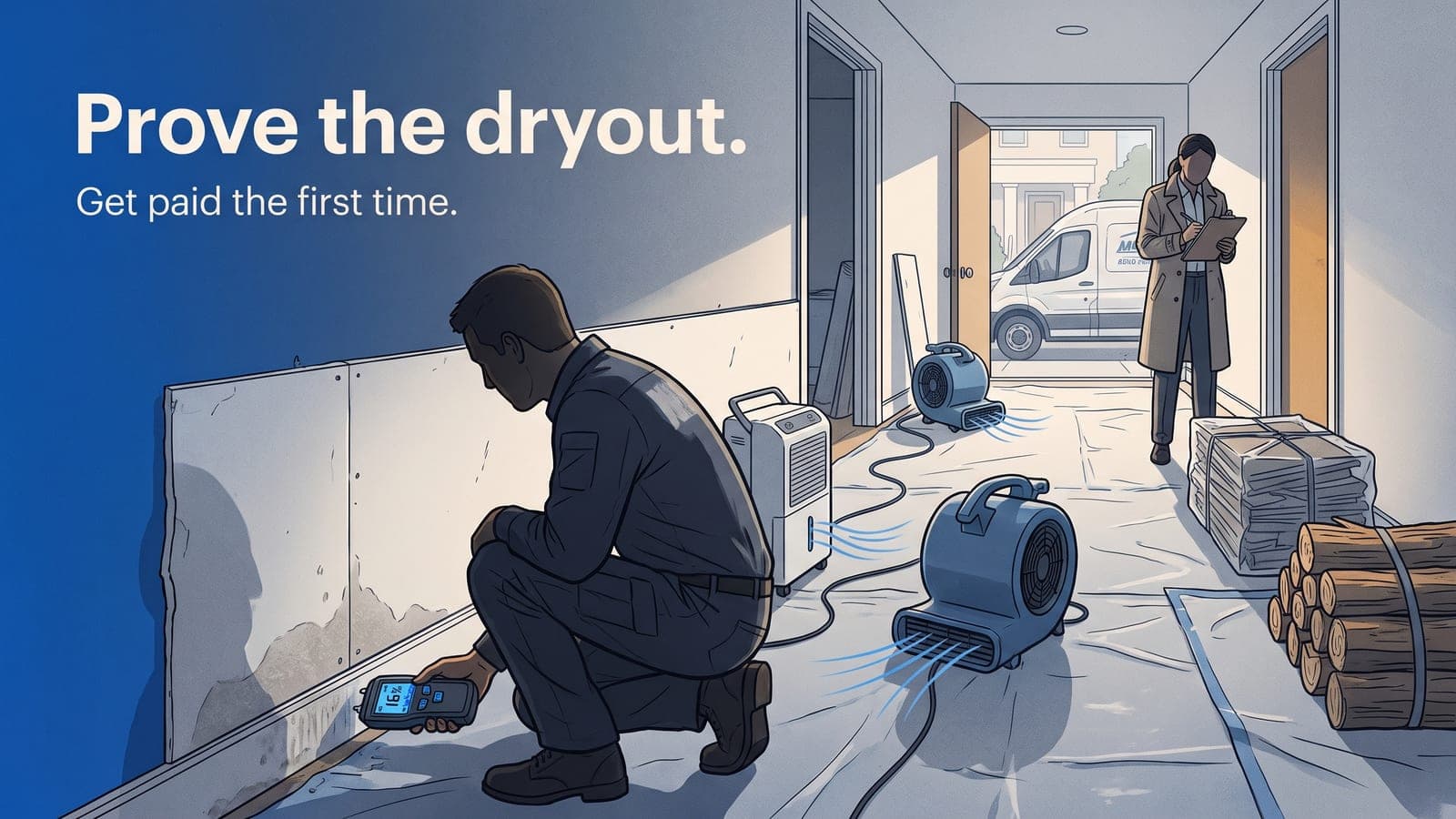
A dryout isn't done when the equipment comes out. It's done when the readings say it's done. Daily moisture logs are the proof, and they need to trend toward dry standard over the days you billed. If you ran equipment for four days, there should be four days of readings showing why it needed four days.
This is exactly what moisture mapping and drying logs that back up your scope covers in depth. The short version: a log that shows readings dropping day over day makes your equipment duration self-justifying. A missing day is an invitation to cut a day of billing.
Tie atmospheric readings to the plan
Temperature and relative humidity, GPP, and the affected material readings together tell the drying story. When they move in the right direction, your plan looks controlled and professional. When they're absent, your dehumidification line looks like a guess.
Write line items in the adjuster's language
Desk adjusters process volume. The easier your scope maps to how they think, the faster it moves. A few habits that help:
- One line, one justification. Every removal, every piece of equipment, every antimicrobial application should trace to a photo and a reading in the same package.
- Use standard terminology. Write "detach and reset," "flood cut at 2 feet," "apply antimicrobial to affected framing" — the language the estimating platforms already speak.
- Don't pad, don't hide. If you ran three days when the readings show two would have done it, the third day gets cut and your credibility takes a hit on the next job. Bill what the documentation supports.
- Keep the claim details clean. Claim number, carrier, adjuster, and date of loss on the job from the start so nothing gets attached to the wrong file. Getting insurance restoration job tracking right on day one is what keeps the paperwork from becoming its own emergency.
Submit one complete package, not a trickle
The fastest rejections come from incomplete submissions. You send the estimate, then the photos two days later, then the drying logs when the adjuster asks. Every handoff resets the clock and gives the file a chance to stall.
Assemble the whole story before you submit: signed work authorization, category and source narrative, room-by-room photos with readings, the moisture map, daily drying logs, equipment list with placement, and the estimate itself. When it all arrives together and every line reconciles, there's nothing left to ask for. That's what first-pass approval actually looks like.
Keeping all of that on one job record — notes, photos, documents, e-signed authorizations, and the drying data — is the difference between a five-minute submission and an afternoon of hunting through phones and email. That's the whole point of running mitigation on a real restoration and mitigation workflow instead of a folder and a group text.
The short checklist
Before you hit send, the scope should let a stranger answer yes to all of these:
- Is the category stated with a source and a reason?
- Does every removal line have a photo and a reading behind it?
- Does the equipment count reconcile with the affected area and class?
- Do the daily logs show readings trending to dry standard for every day billed?
- Are the claim number, carrier, and adjuster attached correctly?
- Is it all in one submission?
Six yeses and you've written a restoration scope of work that's hard to argue with.
Frequently asked questions
How long should I keep running equipment before I demobilize?
Until the affected materials hit dry standard, confirmed by readings against an unaffected reference of the same material — not a fixed number of days. Your daily logs are what justify the duration you billed, so pull equipment based on the numbers, not the calendar.
What if the adjuster disputes my category call?
Point to your documentation: source, migration path, and the S500 basis for your call. A category dispute is really a documentation dispute, and photos of the source plus contamination reasoning usually settle it faster than a phone argument.
Do I need a signed work authorization before I start drying?
Yes. An e-signed work authorization on file before equipment goes down protects you if the claim gets messy later, and adjusters increasingly expect to see it in the package. It's cheap insurance against a "we never approved that" conversation.
Should mitigation and reconstruction be one estimate or two?
Keep mitigation separate. It's emergency service with its own documentation standard, and bundling it with the rebuild muddies both. A clean standalone mitigation scope approves faster and keeps your drying evidence from getting buried.
Writing scopes that clear on the first try is mostly about keeping the evidence organized while your crew is heads-down drying. If you're tired of stitching photos, readings, and logs together after the fact, Job Workflow PRO keeps it all on one job record built for water losses. Start a free trial or email us at sales@jobworkflowpro.com and we'll walk you through it.