Fire & Smoke Restoration: Documenting Soot, Odor, and the Work
Quick answers
- What documentation does a fire restoration job need? Cause-and-origin notes, room-by-room soot and char mapping, odor readings, moisture logs if fire suppression water is involved, before/during/after photos, and a signed work authorization tied to the claim.
- How do you document smoke and soot damage? Photograph each affected surface with a reference for severity, note the smoke type (wet, dry, protein, fuel), and log which materials are cleanable versus non-restorable.
- How do you prove odor was actually removed? Document the source removal, the deodorization method used, and dated readings or notes showing the odor is gone before you close and demobilize.
- Why does fire mitigation scope get pushed back? Because the photos and notes don't match the line items, or the soot spread beyond the obvious room and nobody documented why the extra cleaning was needed.
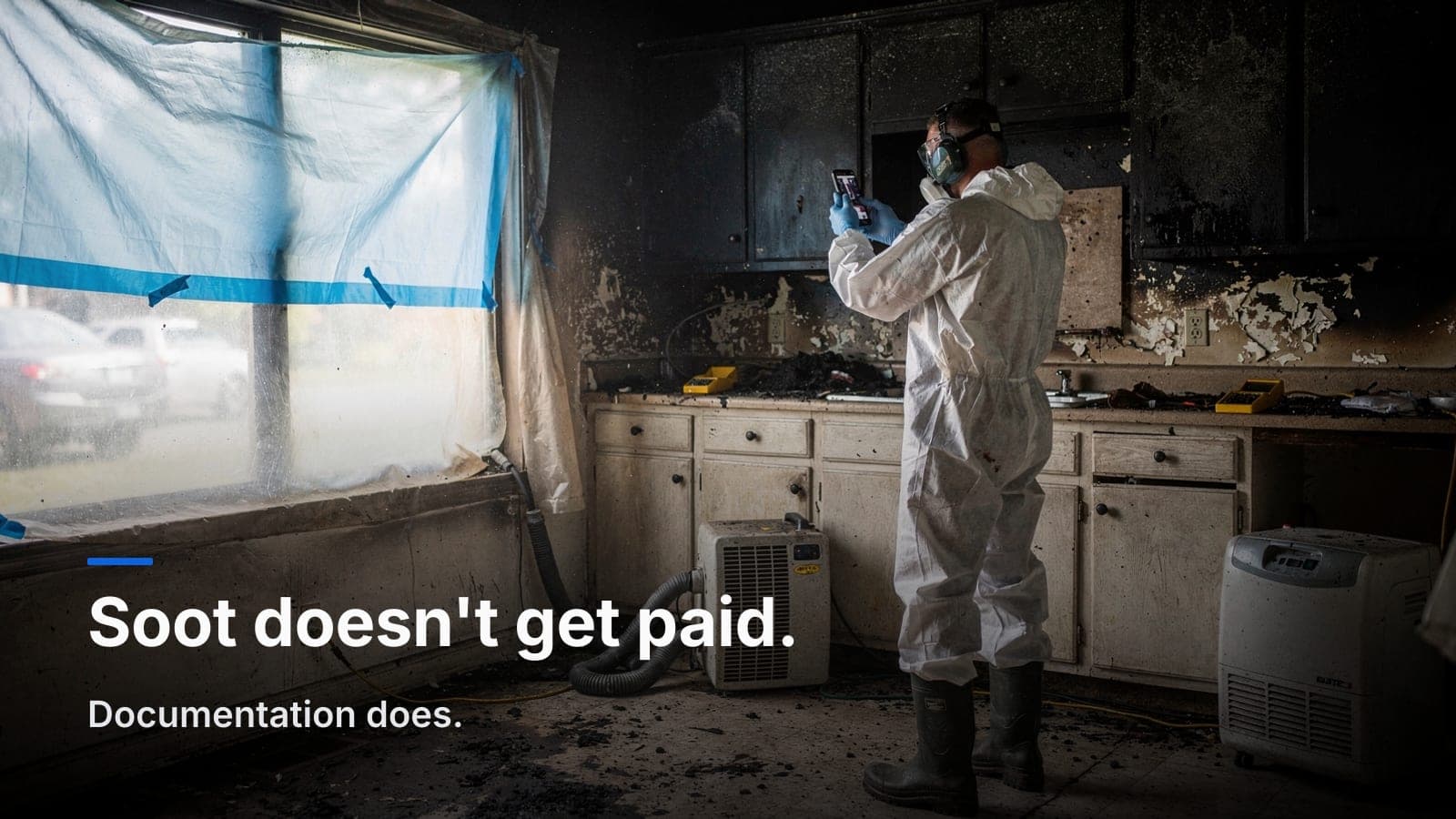
Fire losses are messy to document, and not just because everything's black. You've got smoke that traveled where you can't see it, odor that's invisible on a photo, suppression water soaking into assemblies, and a customer who wants their house back yesterday. The scope you write is only as strong as the paper behind it. Soot on a wall doesn't get paid — a documented, defensible record of soot, odor, and the labor to remove them does.
This is field-first documentation for a fire and smoke job: what to capture, when to capture it, and how to keep it organized so the adjuster approves the first version of your scope instead of the third.
Start at the source: cause, origin, and smoke type
Before you touch a rag, figure out what actually burned and how the smoke behaved. That drives everything downstream.
Smoke isn't one thing. A grease fire in the kitchen leaves a sticky protein residue that smears and reeks long after the surface looks clean. A slow, smoldering fire lays down wet smoke — thick, greasy, hard to remove. A fast, hot fire gives you dry smoke, a fine powdery soot that's easier to wipe but travels everywhere. A fire that involved plastics or synthetics leaves fuel and synthetic residues that stain and hold odor.
Document the smoke type per area in your notes, because it justifies your cleaning method and your labor. "Protein residue on all kitchen surfaces requiring degreasing agent and detail cleaning" reads very differently to an adjuster than "wiped cabinets." Same work, but one of them is scoped.
Map soot the way you'd map moisture
On a water loss you map where the water went. Do the same with soot. Walk the structure and note:
- Which rooms have visible soot, and how heavy (light haze, moderate film, heavy deposit).
- How far the smoke traveled from the origin — down hallways, up stairwells, into closets and HVAC returns.
- Char and thermal damage versus smoke-only damage. These are different scopes.
- Where soot got pulled through the HVAC system, because that's a whole line item people forget.
Smoke goes where air goes. The room two doors down that "looks fine" often has a fine film on the tops of doors and the cold side of exterior walls. If you find it, photograph it and note it. If you don't document it, you can't bill the cleaning, and if you clean it without documenting it, you gave the work away.
Photograph everything, in a way the carrier can follow
Photos are your case. The trouble with fire photos is that black-on-black doesn't read well, and "clean" is invisible. So shoot with intent.
For each affected area, capture the room in context, then move in tight on representative surfaces. Include something that shows severity — a chem-sponge swipe next to untouched soot on the same wall tells the whole story in one frame. Get the tops of cabinets, the backs of appliances, inside the HVAC returns, the char on framing. The same discipline we lay out for photographing contents so the carrier doesn't push back applies to structure: consistent, well-lit, captioned, and tied to the room.
Then shoot the same angles during and after. A before/after pair on the same wall is the single most persuasive piece of documentation you can hand an adjuster. It proves the labor happened and it proves it worked.
Keep every photo attached to the job and the room, not buried in a phone's camera roll. When photos live on the job record next to the notes and the claim number, you can pull the whole story in seconds instead of scrolling through three techs' phones the night before a supplement is due.
Don't forget the water
Most fires get put out with water, and a surprising number of "fire jobs" are half water-mitigation jobs. If the department hit it with a line, you've got saturated drywall, wet insulation, and standing water in assemblies on top of the soot.
That means moisture readings, drying goals, and equipment logs, same as any water loss. Document the affected materials, set your drying targets, and log the readings until you hit them. If you're rusty on that side, the mechanics are the same as any Cat-driven loss — moisture mapping and drying logs that back up your scope covers the record you need. And because suppression water is often contaminated, the water category matters for how you scope demolition and PPE.
The point: don't let the drama of the fire make you sloppy on the water. Both have to be documented, and they're often the same walls.
Odor is the part people can't photograph
Here's where fire jobs get argued. The soot cleaning is visible and provable. Odor isn't. And odor is usually the last thing standing between you and a signed completion.
Document the deodorization as a process, not a result:
- Source removal first. You can't deodorize your way out of soot that's still there. Note the cleaning and any non-restorable materials removed. Charred, porous materials that hold odor — insulation, some drywall, soft goods — go in the demo scope with a reason.
- The method used. Thermal fogging, hydroxyl, ozone, air scrubbing with activated carbon, sealing of framing. Log what you ran, where, and for how long. Each method is a defensible line item when it's documented.
- Verification. Note when the odor is gone and who confirmed it. A dated note from the tech plus a customer walkthrough acknowledgment beats "trust me."
Odor complaints are the callback that eats your margin. A clear record of source removal, method, and sign-off protects you when a customer smells something three weeks later and blames the fire instead of the fish they left in the fridge.
Tie it all to the claim and get it signed
None of this documentation helps if it's floating loose. A fire loss is an insurance job, so it needs the insurance spine: claim number, carrier, adjuster, policyholder. Everything you shoot and log should hang off that. Keeping the claim number, carrier, and adjuster on the job record is what turns a pile of photos into a package you can actually submit.
And get the authorization signed before the real work starts. Fire customers are rattled and the scope can grow fast once you start opening walls. A work authorization signed on day one protects you when the job expands and keeps you from doing $8,000 of demo on a handshake.
The pattern that gets fire scopes approved the first time is simple: the photos match the notes, the notes match the line items, and every extra area of cleaning has a documented reason it was affected. When soot mapping shows smoke reached a room, the photo proves it, and the line item cleans it, the adjuster has nothing to push back on. That's the whole game. Our restoration module is built to keep that chain intact — insurance fields, room-level photos and notes, drying logs, and e-sign in one job record instead of five apps.
Frequently asked questions
Should contents be handled separately from the structure on a fire job?
Usually yes. Smoke-damaged belongings often need their own inventory, cleaning, and disposition workflow, and they're frequently packed out to a controlled facility. Keep contents on a room-box-item inventory with their own before/after photos so structure and contents don't get tangled in one messy scope.
How do I document soot in areas that "look clean"?
Swipe a chem sponge across a suspect surface — tops of doors, cold walls, closet shelves — and photograph the mark next to the untouched area. That single frame documents that smoke reached the space and justifies cleaning it.
Do I need to test for anything on a fire loss?
Depends on the structure and the materials involved. Older buildings may need asbestos or lead considerations before demo, and heavy synthetic fires can warrant surface testing. Document any testing and its results, and defer to the relevant standards and your firm's protocol.
What's the fastest way to lose a fire scope supplement?
Discovering affected areas after you've already demobilized. Do your full soot mapping up front and document every affected room on the first walk, so a supplement is a documented addition rather than an argument.
How long should I keep fire job documentation?
Keep the full record — photos, logs, authorizations, and the final scope — attached to the job well past closeout. Fire claims can reopen over odor or hidden damage months later, and the job record is your defense.
Fire jobs reward the crews that document like they'll have to defend it, because sometimes you do. If you want the soot mapping, drying logs, photos, and claim details living on one job record instead of scattered across phones and paper, start a free trial or email us at sales@jobworkflowpro.com and we'll walk you through how other restoration shops run it.