Stop Losing Air Movers: Equipment Tracking on a Water Loss
Quick answers
- Why do restoration companies lose air movers? Equipment gets placed and pulled by different techs across multiple jobs, and without a log tying each unit to a job number, nobody knows what's still in the field.
- How should I track equipment on a water loss? Log each unit by ID against the job when you place it, note the day it went in, and check it off when you pull it — so placement, run days, and retrieval all live on the job record.
- What restoration equipment gets lost most? Axial air movers, because they're small, cheap-feeling, and placed in high volume, so a missing one or two rarely gets noticed until inventory day.
- Does equipment tracking help billing? Yes — accurate placement and pull dates give you defensible equipment-day counts for the carrier instead of guessing at line items.
Every restoration outfit I know has the same quiet leak in the P&L: equipment that never comes home. You buy a truckload of axial air movers in spring, and by fall you're twenty units light and nobody can tell you where they went. They're on a job that closed months ago, sitting in a customer's garage, or they walked off with a tech who left. It's not theft most of the time. It's just that nobody was tracking them.
That gap costs real money. A single air mover isn't much, but a fleet's worth of missing equipment over a year is a new dehu you didn't need to buy, or two. And the same sloppiness that loses you hardware also loses you billing — if you can't say when you placed and pulled, you can't defend your equipment-days to the carrier.
Here's how to close it without turning your techs into inventory clerks.
Why equipment walks off water losses
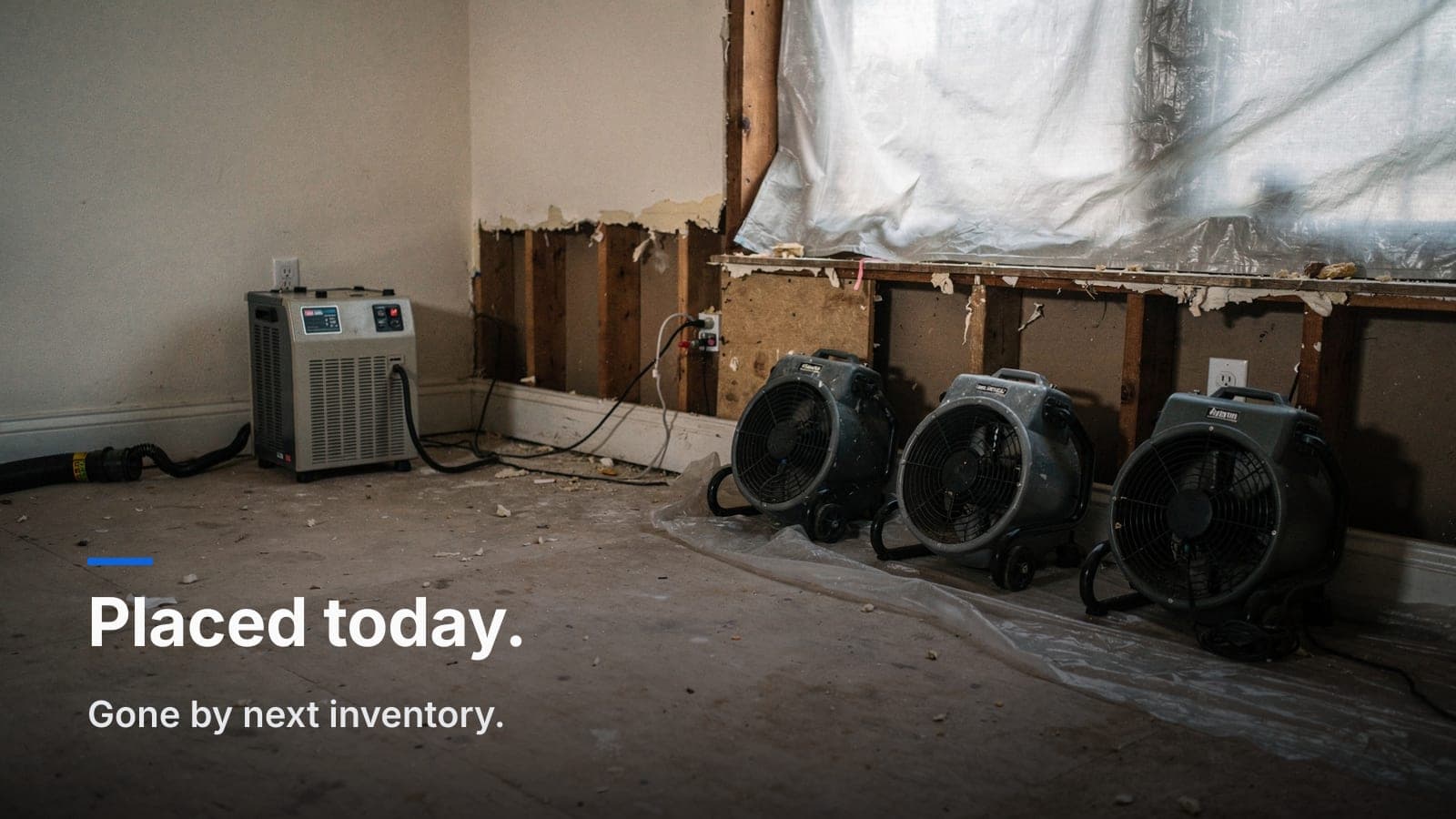
The problem is structural, not moral. On a water loss you place equipment fast — flood cuts done, plastic down, air movers along the baseboards, a dehu in the corner with the condensate hose run to a drain. That's day one, often by whoever's on the truck.
Then a different tech takes readings on day three. Someone else pulls half the air movers when the drying goals are met. Someone else closes the job. At no point does one person own the full lifecycle of unit #A-114. So when the job wraps and the count is short, there's no thread to pull.
Multiply that across a dozen open losses and you can see how a fleet leaks. The equipment isn't lost — it's just untracked, which for accounting purposes is the same thing.
Give every unit an ID and stick to it
You can't track what you can't name. Every air mover, dehu, air scrubber, and heater needs a permanent, readable ID. Not the serial number buried on a sticker — a short unit number you assign: A-101 through A-160 for air movers, D-01 through D-12 for dehus, and so on.
Label them where a tech can read the number from three feet away, on a surface that survives the field. Then that ID is what gets logged, photographed, and checked off. This is the same logic that makes box labeling and barcode systems work on the contents side — a durable identifier is the whole foundation.
If you're big enough to run barcodes or QR tags, great. If you're not, a stenciled number and a laminated master list will get you most of the way. The point is that A-114 always means the same physical machine.
Log placement against the job, not in a notebook
Here's where most systems fall apart. The equipment log lives in a spreadsheet on the office computer, or on a clipboard in the truck, or in the lead tech's head. None of those are attached to the job.
The fix is to log equipment placement on the job record itself, the same place your moisture mapping and drying logs already live. When you set units on a loss, you record:
- Which units — by ID, e.g. A-112, A-113, A-114, D-03
- What room — living room, hall, primary bath
- The date placed
Now the job knows what equipment it's holding. Any tech who opens that job on the mobile app sees the current placement — no guessing, no calling the office. And because it's tied to the job number that runs through your whole insurance restoration workflow, the equipment story and the claim story stay in the same file.
Photograph the placement
Snap the room after you set equipment. It's a two-second habit that pays off twice: it documents the drying setup for the carrier, and it's a visual record of exactly which units are where. When you come back to pull, the photo tells you if anything's missing before you leave the site.
Track run days, because that's what you bill
Equipment tracking isn't only about not losing hardware. It's about billing. Carriers pay by equipment-day, and "we ran three air movers for four days" is a number you either have or you invent.
When placement and pull dates live on the job, the equipment-day math is done for you. Three air movers placed Monday, pulled Friday — that's your line item, defensible because the dates came from the field log, not a memory. Same discipline that makes a water mitigation scope get approved the first time: you're not asking the adjuster to trust you, you're showing them the record.
Undercount and you eat the drying cost. Overcount and you invite a pushback that slows the whole invoice. Accurate run days from a real log are how you get paid what you actually earned.
Close the loop on the pull
The pull is where units go missing, so treat it as its own step. When a tech retrieves equipment, they check each unit off the job's placement list. Anything not checked off is still in the field — and now you know it the same day, not at year-end inventory.
Make the rule simple: a job doesn't move to "complete" until every unit placed on it is accounted for. If A-114 is still showing as placed, the job stays open and someone goes back for it. Tie that to your job status workflow and the platform enforces the habit for you instead of relying on discipline.
That single gate — no close with equipment outstanding — will catch more lost units than any amount of nagging.
Roll it up across every open job
Once every job carries its own equipment list, you can answer the question that used to be unanswerable: where is all my equipment right now? Sum the placements across open jobs and you know how many air movers are deployed, how many are on the shelf, and whether the "missing" dozen are actually sitting on three loss sites you forgot about.
That's the difference between guessing at your fleet and knowing it. It also tells you when you genuinely need to buy versus when you just need to go collect. Our restoration package is built so equipment placement rides on the same job record as your drying logs, work authorizations, and claim details — one file, one truth, from first reading to final pull.
Frequently asked questions
How often should I do a full physical equipment count?
Even with per-job tracking, do a physical count quarterly to catch damaged units, mislabeled machines, and anything that slipped through. The per-job log tells you where equipment should be; the physical count confirms it and flags maintenance needs.
Should I track equipment maintenance the same way?
Yes — log filter changes, cleanings, and repairs against each unit ID so you can see which machines are due for service. A dehu that's not pulling water on a job is worse than a missing one, because you don't find out until the drying stalls.
What about equipment a subcontractor or franchise partner places?
Assign their units their own ID prefix and require the same placement-and-pull log on the job. If they can't produce which units they set and when they pulled them, you can't bill it cleanly or hold them accountable for what walks off.
Do I need barcodes, or is a numbered list enough?
For most small and mid-size shops a durable stenciled ID plus per-job logging is plenty. Barcodes and scanning help most once your fleet gets large enough that manual entry becomes the bottleneck.
If your air movers are quietly disappearing and your equipment-days are more guess than record, this is fixable without adding paperwork to your techs' day. Start a free trial and put equipment placement right on the job record, or email sales@jobworkflowpro.com and we'll walk through how other restoration shops set it up.